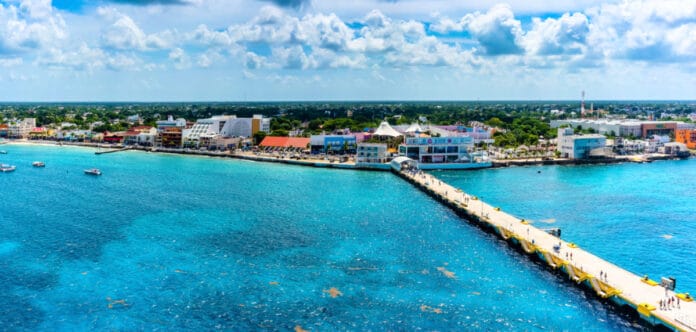
Cozumel is an Island off the Northeast coast of Mexico’s Yucatan Peninsula known for its white sand beaches, crystal-clear turquoise waters, world class restaurants and shopping, wild eco reserves, and of course some of the best diving in the world. The once little known island hideaway has become a renowned getaway for vacationers and adventure seekers alike. Ironman races are often held at some fantastic destinations and Cozumel ranks high on the list for triathletes looking to combine their challenge with an extended vacation.

Why Ironman Cozumel?
Just after New Years in the infancy of 2021 I scoured the Ironman website for available races to choose from for my first 140.6 and ultimately landed on Cozumel. The course is known for being flat and fast and occasionaly provides a current boosting athletes on the swim, a “downhill swim” as I’ve affectionately begun to refer to it. The course offers its own unique challenges in the form of heat, humidity, and high winds.
The reason I choose Cozumel had nothing to do with the rumored swim current, or the pristine vacation getaway that I could pair the race with, but was primarily due to the impact COVID had on the 2020 racing season.
I was signed up for Ironman Connecticut 70.3 in May of 2020, which was deferred to Lake Placid in July, deferred again to Indian Wells in December, and finally deferred to St. George in May of 2021. I was one of thousands of athletes suspended in training and financial limbo as races were constantly cancelled and moved around. With new waves of COVID restrictions being implemented worldwide as I was in the process of selecting a race, it was difficult to decide on a destination to focus on this far in advance. If I was going to chase my dream of completing a 140.6, putting in the extraordinary amount of time and work required to prepare for such an endeavor, I wanted to be sure the race would actually go as scheduled.
This brought me to Ironman Cozumel. Throughout the pandemic Mexico had been reliably lenient with travel restrictions in general. The race was an end of season race that would allow time for things to simmer down in addition to giving me ample time to train and prepare. Most importantly in my decision process was the fact that Cozumel was one of the only Ironman events to run as scheduled in 2020 while the world was still in the height of the COVID pandemic and vaccines were not yet available. This little nugget made me believe the race was the least likely of any of the options on the calendar to be cancelled or pushed and ultimately got my fingers clicking on the register button to secure my place on the starting line for November 21st.
Cozumel Specific Preparation
Any Ironman requires a prescribed amount of swimming, cycling, and running. Long endurance sessions, form/skill sessions, intervals, and any number of other strategies depending on the complexity of one’s particular program. However, I did have certain SPECIFIC training strategies to prepare for the unique challenges that Cozumel would present.
Heat Acclimation: 2-3 weeks before the race I began to train my body’s tolerance to regulate temperature in hot/humid conditions. Being November in Boston required creative ways to elevate my core temperature high enough to create an acclimation response. I utilized 2 strategies to do this; steam room and overdressed workouts. The steam room worked like a charm, but I would advise against hour long sessions like I did as I earned myself a Darwin award by burning my cheeks and nose the week before the race by doing so.
Sweat rate testing: I performed a sweat rate test a couple weeks before the race to determine how much water I would lose per hour in the Mexico heat and humidity to ensure I planned my water and salt intake accordingly. Falling behind on hydration in Cozumel would certainly mean a lot of walking or a dreaded DNF.
Bike Aero Position Training: The bike course on Cozumel is a 3-loop, mostly flat, and famously windy. This makes maintaining an aerodynamic position critical to achieving your best time. As with any flat course it also means that the entire bike course will be spent pushing power to the pedals in the aero bars. With hilly courses there is more opportunity to change position slightly, stretch, and to coast downhills for recovery. To ensure the most comfortable Cozumel bike split I spent long hours in the aero bars in training and used my indoor trainer ERG mode to ensure I couldn’t back off the power in those long sessions.
Traveling to Cozumel
As mentioned in my reasons for choosing Cozumel for my race, travel from the US to Mexico during COVID is relatively lax when compared to other countries. There is no proof of vaccine or negative test requirement to enter Mexico.
Flying into the race there are 2 airport options; Cancun International Airport or Cozumel International airport. I would highly recommend flying directly into Cozumel, even if there’s a connecting flight or the flight is a bit more expensive. Cozumel International is about 10 minutes from the downtown and hotel areas, where you will likely be staying. It also is a much smaller less trafficked airport meaning the baggage claim and exit logistics are a bit easier.
If you opt to fly into Cancun you will then need to take a 1 hour taxi to Playa del Carmen and take a 40 minute ferry to the island. Traveling with a bike case greatly magnifies the headache of this ordeal and will likely eliminate the benefit of any penny pinching on the flight itinerary.
Choosing a Stay
There are a ton of great options on the island ranging from host hotels and resorts to Airbnbs. With a point to point swim and separate T1 and T2 zones, any of the options will require some moving around during your pre race logistics. Many host hotels offer shuttle services to ease the pain and stress.
I opted to stay in an Airbnb in El Centro and found it to be ideal. I arrived a week early to assist with acclimatization and ease pre race pressure. I was working remote this week and needed ample space for work as well as for all of my gear. The final tip of the scales came courtesy of the ability to wash my clothes and kit throughout the week and cook my own meals leading up to the race. For about $80 a night I got a great apartment with multiple pools within walking distance to the best cafes, shopping, and restaurants in Cozumel.
All of the options in the Hotel Zone and El Centro are likely fine so I wouldn’t spend too much time stressing over the absolute best location in this general area for the race.
Before the Race
November lies right in the middle of Cozumel’s rainy season. This can mean an equally likelihood of sunny days, passing showers, to full on hurricanes hitting the island with weather forecasts changing by the minute and still being utterly useless. Is there any profession with less accountability than meteroligist?
The week leading up to the race had rain… LOTS of rain. I’m talking about the kind of biblical dumping that flooded roads and would send Noah running to his ark thinking the time had come.
I opt to try not to worry about the uncontrollable so I simply hit my taper workouts and hoped after each rainy session that conditions would improve by Sunday.
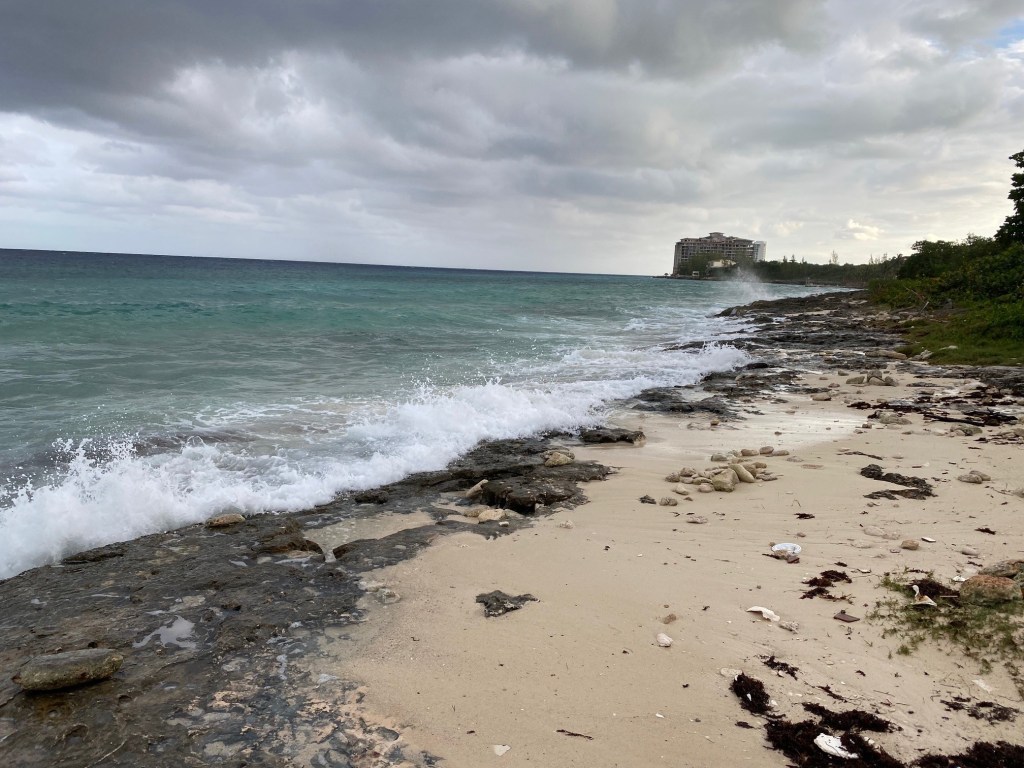
Cozumel’s rocky coastline and boat traffic makes safe open water swims a challenge, but I found Playa la Rocas in the hotel zone to be a great option for getting a salty splash.
The week leading up to the race the famed Cozumel current was ripping. With the current I was swimming record pace, against the current I was in an endless pool, staring at the same rock as I swam as hard as I could while tropical fish looked on at the futile effort from below. The current at Cozumel comes and goes, this was one environmental factor I hoped would remain for Sunday.
Race Morning
My alarm went off at 4:20 AM. T1 would open at 5:30 and I would need to eat, shower, get dressed, then find a cab to take me to Chankanaab park before T1 closed at 6:45. Then I would need to board a bus to the swim start in time to get my place at the front of the age group swim start.
Traffic backed up from Chankanaab Park so I opted to pay my driver and walk a mile to T1 to make sure I could get my nutrition and bike computer set up before it closed.
The shuttle lines to Marina Fortuna were incredibly long making me fear I would miss my preferred swim start. At 6:50 the skies opened up drenching all of the athletes waiting in line as lightening lit up the sky…not a good start.
I was able to board and get to the swim start just in time as the lightening had not caused a race delay.
I bring up the race morning simple to advise future IM Cozumel athletes to add plenty of time to their morning logistics. I had thought I had plenty of buffer and still barely made my start.
The Swim
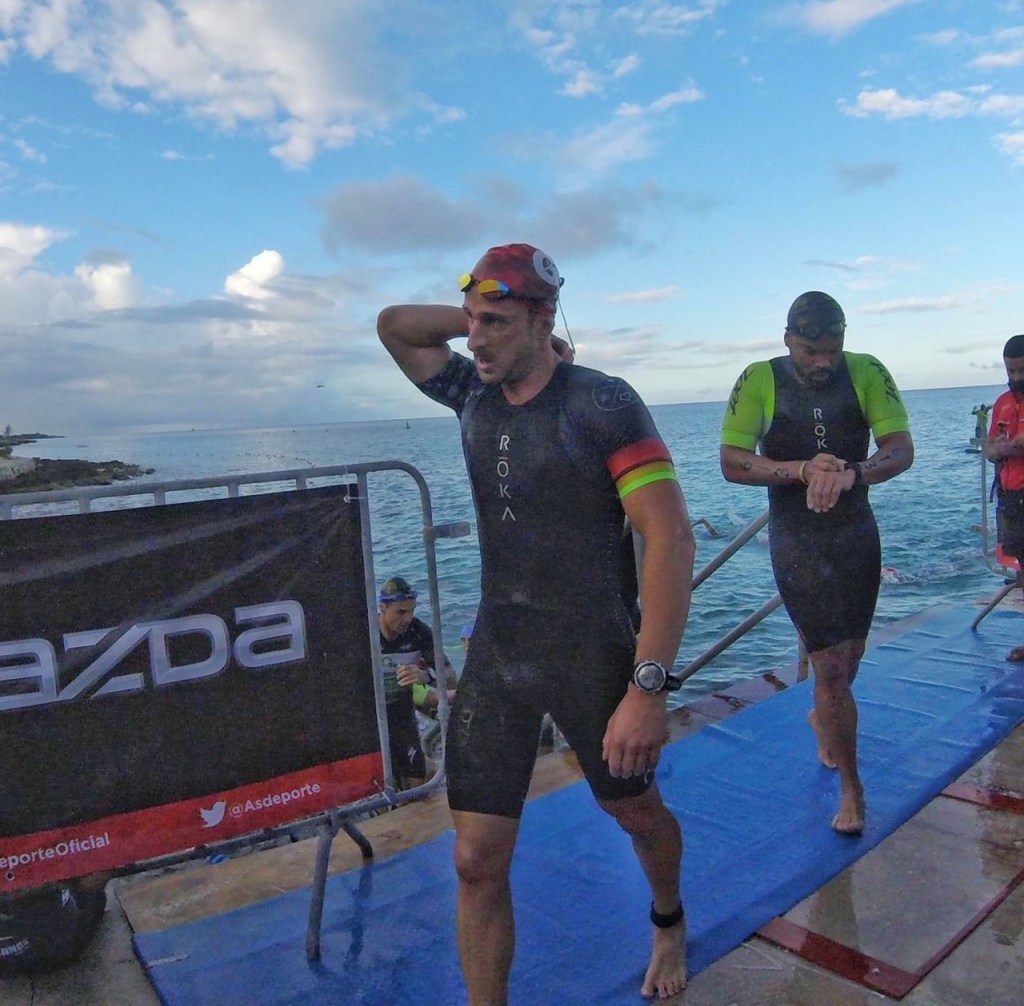
Ironman Cozumel features a point-to-point ocean swim that borders a coral reef. The warm water means Cozumel is not a wetsuit legal race. Any anxieties athletes have of swimming without the added buoyancy of a wet suit are typically soothed by Cozumel’s famous assistive current.
I got off the shuttle bus from T1 to the swim start at Marina Fortuna. The swim start would be a rolling start from the end of a dock at the Marina and end at Chankanaab Park 2.4 miles south. Like many triathletes, the swim was the bain of my existence when I started racing. I had no swim background before triathlon and could never get comfortable in the water in a race. Now as I toed the start of my first Ironman I was confident in the water having spent most of 2021 focusing on greatly improving my swim.
The starting corral was divided by expecting swim times incrementally ranging from under 1 hour to over 2 hours. I jumped in at the front of the corral with the under 1 hour group. I felt this maybe to be a slight stretch; however my from my experience in other races I knew there would be plenty of athletes gaslighting themselves into a faster corral that would inevitably create a wall of slow swimmers in the water. Swimming behind a wall of people kicking me in the face for 2.4 miles was not the type of race start I was interested in.
My plan was to go out moderately hard, settle into my stroke, and to stay slightly to the outside of the pack to give myself the freedom to swim, but not so far outside of the pack as to lose the efficiency benefit of the draft zone.
Every 3 seconds another 2 athletes plunged into the warm turquoise waters to begin their race, and with every plunge I moved a step closer to the edge of the dock. My heartrate elevated slightly with prerace excitement. I was about to take on my first Ironman! Unlike other races when I felt anxiety beginning a race, I felt surprisingly calm. This is the biggest race yet! How could I be feeling better entering the water now than in any number of short course races I’ve participated in?!
Preparedness. The intense training protocol for the Ironman and my focus on swim training made me know I was ready. Don’t shirk on your training and you’ll be gratuitously thanking your past self come race day.
I jumped off the edge of the dock and began swimming. The water was crystal clear giving plenty of opportunities to get distracted by the reef and tropical fish underneath. I almost had to remind myself this wasn’t a snorkeling trip. The current was alive and well today and it appeared I had seeded myself perfectly at the start as the usual royal rumble of the triathlon swim was replaced by a quite enjoyable open water swim. At about the midway point I even looked down to see a scuba diver standing on the ocean floor waving to the athletes while spectating the race from below! Spectators were not allowed to enter the swim start or finish areas so I had to admire this lad’s ingenuity… certainly an honorable mention for the most zealous support crew award.
In a surprisingly short period of time I could see the swim exit on the opposite side of the manatee enclosure at Chankanaab Park. I must be flying! I thought to myself. I resisted the urge to check my watch to confirm a pace. If somethings going well it’s best to leave well enough alone.
The exit of the swim is a narrow stairset going up to the dock at Chankanaab that creates a bit of a bottleneck on the exit. Nonetheless I was entered T1 at 54 minutes, 50 seconds… and unbelievably fast swim for me. I almost had to take a quick glance back to make sure I didn’t have a propeller on my ass. (If anyone steals that idea I expect royalty checks in the mail.)
The Bike
The transition zone was in the parking lot of Chankanaab park which was designed as if it was drawn in a Dr Seuss book. It was totally random, twisy, turvy, and any other confusing word you can think of. Due to the random layout athletes were running in opposite directions everywhere adding to the chaos. I took a video of the route from the water to my bike rack the day before during the bike check in to try to rehearse the route to my steed a few times before race day. Nonetheless, I took a wrong turn and ended up taking an extra lap around a row of racks as a penalty.
Once the difficulty of actually finding my bike had been settled I was able to run out of the bike exit, mount my bike, and begin powering South down the main highway of the island, Quintana Roo Route 1.
The Cozumel bike course consists of 3 loops of the South half of the island. The course is known for being windy typically with a Northeast wind and gusts on the East side of the island; however, the windspeed and direction can frequently change so forecasts shouldn’t be relied upon.
After reaching Punta Sur you pass the island dive bar, Rasta Bar, at the southern tip and turn North. The road on the East side of the island rides along the top of a beautiful rocky coastline. The road is almost totally exposed on this side of the island leaving athletes to take the brunt of the wind. I also would highly recommend Rasta Bar for the day after the race for your… errr… recovery?
The Cozumel bike course was nearly devoid of any restrooms, but what better time to christen my Madone than during my first Ironman? A tri bike isn’t truly a tri bike until it has been peed on after all.
For all the “Pee on bikes” T-shirts and jokes in internet forums I found this to be much harder than it would seem. Trying to maintain power in an aero position while emptying your bladder should be a sport in itself. Now also is a good time to interject a lesson from the school of hard knocks… It turns out that urine, especially when you are dehydrated such as, I don’t know, when doing an Ironman in tropical heat, is highly acidic. Every little chaff I had from 100 miles of cycling after a swim in the salty ocean instantly lit up in pain. It felt like I had a colony of fireants in my chamois. Luckily endurance training leaves you no stranger to handling pain, even the weird embarrassing kind.
The first 2 loops of the course offered little wind and some cloud cover leading to my average speed of about 23 mph and some very fast splits. Conditions on the 3rd loop changed drastically.
Rounding Punta Sur for the 3rd and final time I turned North to see an ugly dark motherfucker of a cloud ahead. Winds began to pick up challenging my aching legs to maintain my speed.
With 20 miles to go I hoped I could win the race against the storm to avoid crossing the island in whatever fury that cloud was going to bring.
As I turned West to cross the island back to El Centro the skies opened up with a torrential downpour that immediately began flooding the roads. I was wrestling with my handlebars to keep the cross winds from sending me to the pavement. A deafening thunderclap made me jump in the saddle and lightening bolts struck on either side of the road, seemingly only a few hundred yards away. To understate the obvious, this was NOT good. I should have been more specific when I prayed to the triathlon gods for a few more watts.
With about 12 miles to T2 I was on a flooded road, totally exposed, with nowhere to seek shelter. I feared the race officials would stop the race, but even if they did there was no where to go to get out of the storm. I did the only thing I could and tried to push more power to the pedals to get to safety faster. At this point the winds had brought my average speed down to 22 mph. If I could avoid electrocution and stay upright I should be able to get a bike split just over 5 hours.
After riding through a few flooded roundabouts I was back in El Centro and cruised into the T2 at the Mega Soriana parking garage at 5 hours, 9 minutes.

The Run
T2 went much more seamlessly than T1. With the run gear and bike racks laid out in organized symmetric rows in the parking garage I did not get lost this time. Oil on the parking garage floor mixed with running on wet plastic cycling cleats sent some athletes to the concrete, I had made note of this added obstacle during check in the day before so with my short strides I was able to stay upright.
With my carbon plated New Balance racers laced up I headed out into the crowded streets of El Centro to begin my first of 3 loops out into the Hotel Zone of the island.
Whereas the bike course was a lonely endeavor through largely isolated sections of the island, the run course kicked off with some powerful crowd support. For the first couple of miles through El Centro there were people lining the streets. Those with sharp eyesight would read the fine print under my bib number and shout “Let’s go William, you got this!”. Restaurants had set up stages along the street with DJs and full bands keeping the party going.
The temperature and humidity had climbed into the 80s, but luckily the sun was remaining hidden. I had heat acclimated, but from my training runs I knew that a strong sun was my kryptonite.
At about this time I was passed in the opposite direction by a tall athlete in a white tri suit that was absolutely MOTORING. This guy was in a dead sprint. It only took me a moment to recognize the current Olympic Triathlon champion and soon to be winner of Ironman Cozumel, Kristian Blummenfelt. One of my favorite things about triathlon is that it’s the only sport where age groupers go out onto the course to do battle on the same field of play as the professionals. There are no barriers, no security, nothing differentiating you from your sports heroes other than your race time. The gold medalist was about to end his run just as mine began, but at that moment we were still technically competitors putting down our best efforts on the same course.
I hydrated at every aid station, which because of the multiloop course were laid out at nearly every kilometer. I completed the first of my 3 loops feeling incredibly strong maintaining a sub 8 minute pace. As I checked my watch I could be my heartrate staying in the mid 130s, meaning the heat was having no ill effects on me yet. It was at this moment I KNEW I was going to be an Ironman. I was on pace for a sub 10 hour finish so even if cramping or illness struck in the remainder of the run there was nothing that was going to stop me from hitting that finish line before the cutoff. The elation of this realization made each step I took feel a little bit lighter in the second loop.
On the second loop I spotted my girlfriend, Alex, rocking her “Ironman Support Crew” tank top on the side of the road. Pain was beginning to set in to my legs but a little tough love from the sidewalk kept the wheels turning “Pick up the pace you baby!”. You know it’s love when they don’t hesitate to take shots at you 125 miles into a race.
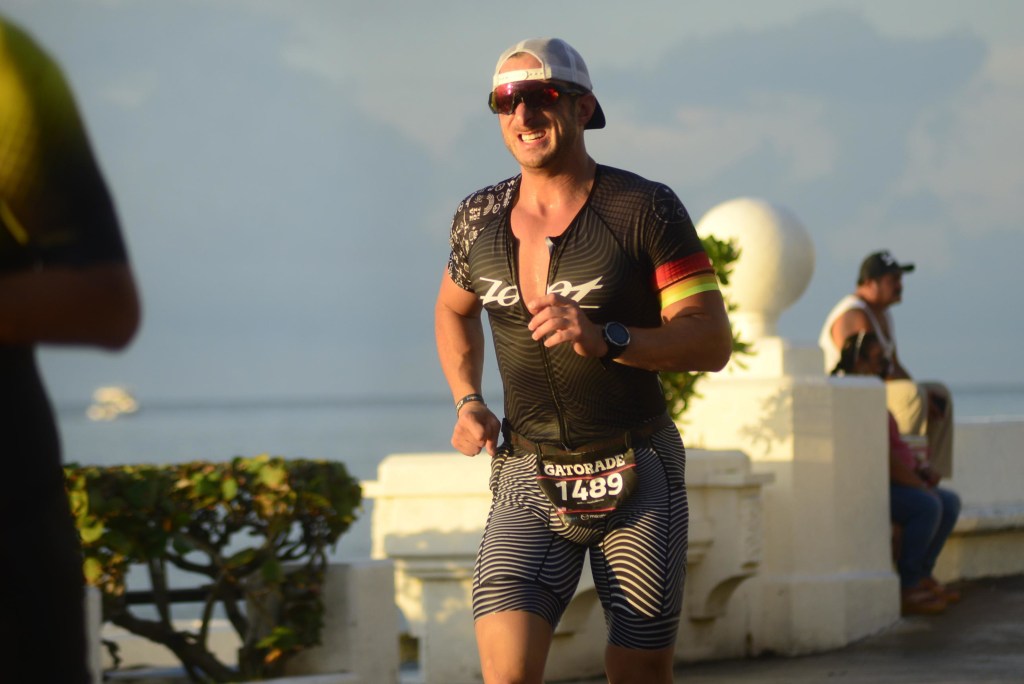
At the turnaround of my second loop my worst fear of the race was realized. The clouds parted to make way for a punishing Mexico sun at arguably the worst time in the race. I flipped my hat visor around to cover my face and my aid station strategy shifted to hydrating as well as trying to load as much ice into my tri-suit as possible. My race photos were sure to look odd with ice cubes compressed at every random corner of my skin tight tri suit but at this moment survival was more important than style points.
I slowed down slightly, but my heart rate was in control. It appears my strategy was working at keeping my UV nemesis from crushing my finish time hopes. The lack of toilets on the run also allowed me to learn it’s possible to pee on running shoes as well as bikes!
As I began the 3rd loop pain escalated. The cumulative pushing and pounding on my legs made my body scream. Every joint and muscle from my feet to my neck was throbbing. This is when mental toughness becomes paramount. I had read that just the act of smiling can reduce perception of pain. With a fresh load of ice in my tri suit and a maniacal forced grin I pushed through the final 8 miles of the race.
The Finish
Heading into the final mile of the run I had never been in more pain in my life, but I enjoyed every second of it. Flashbacks to moments of early morning alarms, never ending training rides, and past races flooded my brain. I’m sure the crowd must have been deafening, but all I heard was a muffled background hum like Charlie Brown listening to his teacher speak. ” Wah, wah, wah wah wahhh wah”.
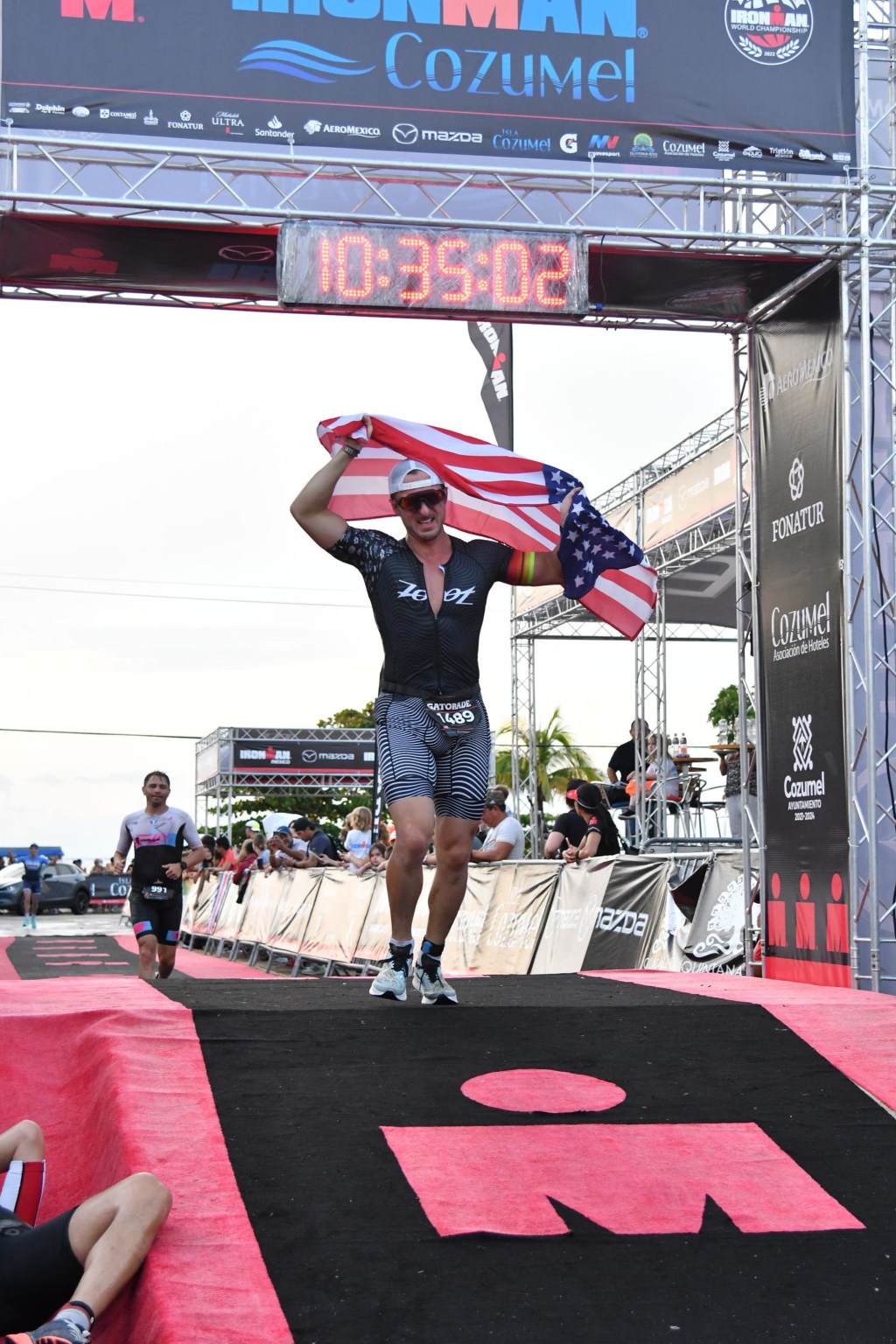
I entered the finishing shoot and heard an official shout “What country? Que Pais?”
“United States” I was able to gasp through my uncontrollable grimace.
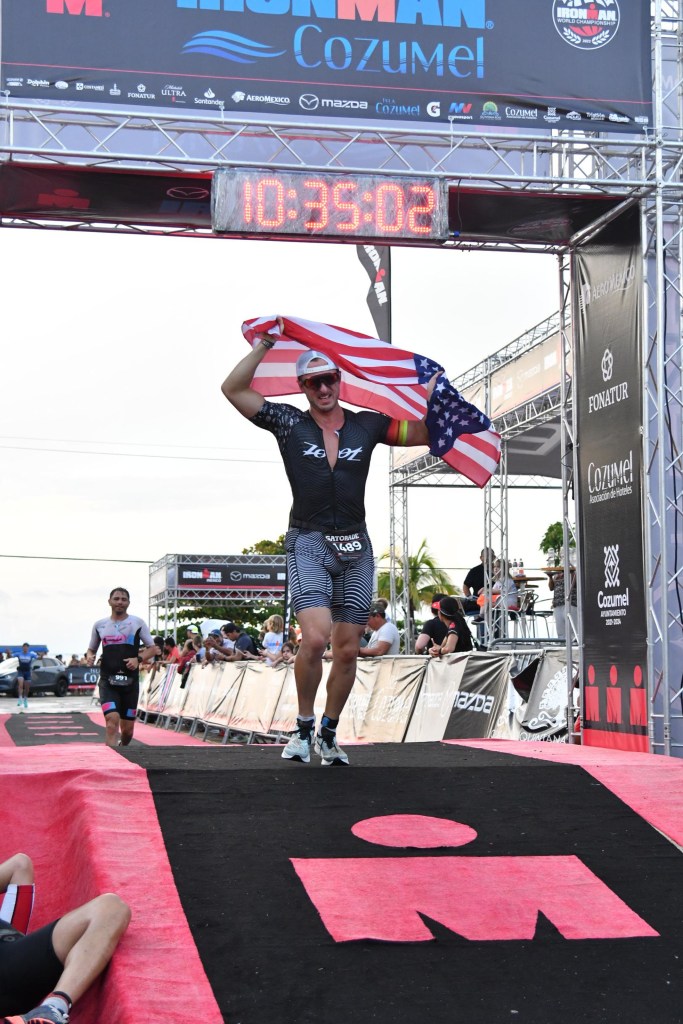
Someone handed me a flag of the stars and stripes and I rounded the corner to bring it home in the last 100 yards of the race.
So many times in training runs and while sitting at night in my compression pants with my body an absolute wreck I had visualized this moment. It was here now, I was mere steps away from realizing my dream of becoming an Ironman.
I grabbed the two top corners of the flag and held it high over my head, charging up the ramp to the finish line. As I crossed I shouted out a victory scream, wobbled a few steps and then leaned on a barrier as another uncontrollable reaction ensued. I’m not an overly emotional person but the culmination of years of hard work pursuing my dream had been realized and what little hydration I had left in my body made itself known in tears of joy.
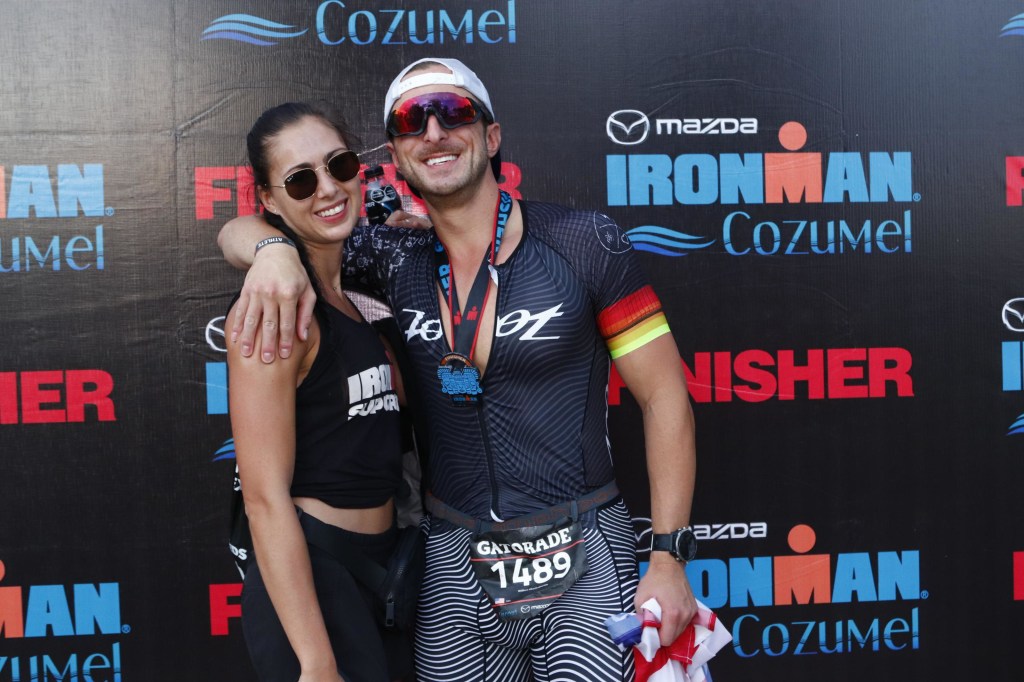
I found Alex and gave her the sweatiest, stinkiest hug of her life then did my best Frankenstein walk to the end of the chute to claim my medal. With my new jewelry proudly being worn around my neck I found the first patch of grass I could and promptly collapsed. The bad news was the grass was wet muddy and stinky. The good news was I had finally found the elusive porta potties.
I finished the marathon in 3 hours, 53 minutes. Crossing with an official race time of 10 hours, 9 minutes and absolutely shattering my stretch goal for the race of under 11 hours.
Post Race
When I was done laying in the filthy puddle I painstakingly got back on my feet. Every time my body moved I let out a grunt.
Lift the leg “argh”.
Grab my bag “argh”.
Step off a curb “ARGH!”.
Alex was incredibly patient with her newly crippled boyfriend as we inched back over to T2 to retrieve my steed. She decided not to listen to the symphony of grunting for the mile walk back to our Airbnb and found a taxi large enough to fit the bike inside to take us back to our stay.
Laying in the bed was rightly off limits in my current state of filth so the couch it was… I collapsed and began uncontrollably shivering. My legs needed the assistance of my arms to even get up onto the couch.
I laid there for 30 minutes shivering and staring at the ceiling thinking about the day. For people that have completed an Ironman you may understand. For those that haven’t, there’s no way to properly put into words the realization hitting you that you’ve reached a goal so few even seek and even less acheive.
Years of training, 6-7 days a week, 2-3 workouts a day, hours of nutrition planning, studying skills and tactics all to chase a dream that for most of that time you didn’t really believe was even possible for you, and then to realize that dream. To my mind, there is no better feeling in the world.
After I finally worked up the strength the grunt my way into the shower, Alex and I went out for a celebration dinner. 2 sips into a frozen margarita and I was already flying high. Ironmen are cheap dates.


 Khach Me If You Can
Leave a comment