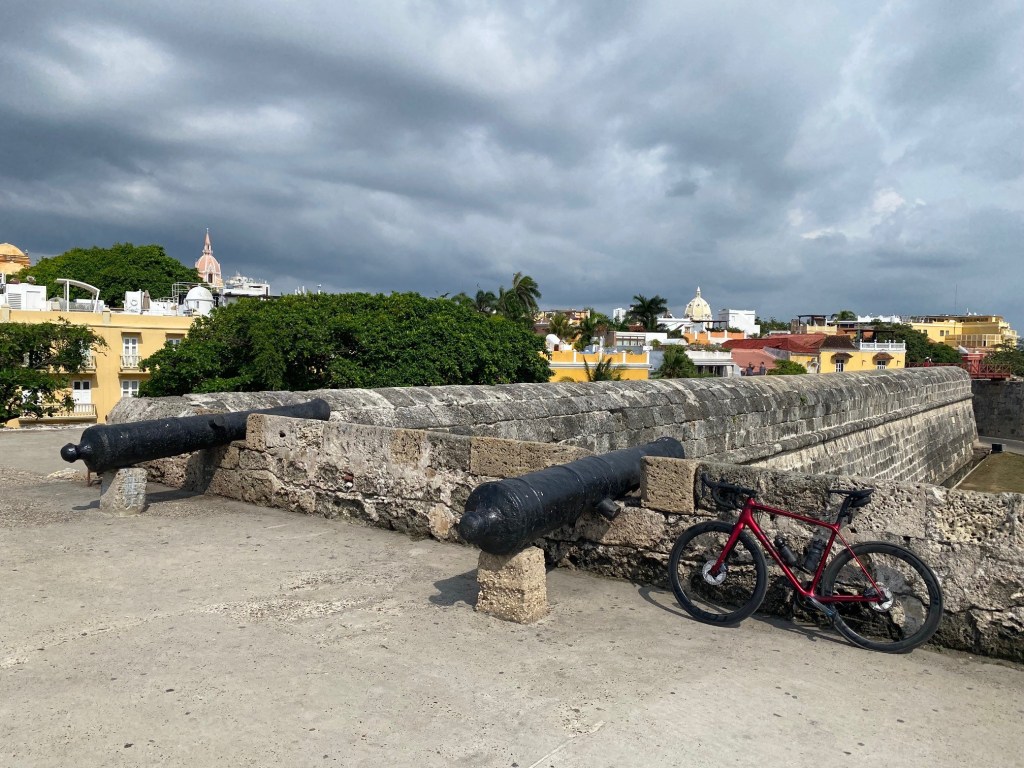
Colombia Cycling
Colombia is a cycling country. The mountains in the center of the country around Bogota and Medellin offer some of the best riding in the entire world and produce some of the premier cyclists in the pro peloton. Fresh off of a Colombia cycling adventure in December (that I discuss here.) I was excited to fly my bike back down to explore the roads of the country’s Northern Caribbean coast.
Countries are not Homogenous
Foreigners tend to lump all areas of a country together, meaning the thought often is Colombia is Colombia, and that’s that. It isn’t until one looks introspectively at their own homeland that you realize this is a drastic oversimplification. Regarding my own country of the United States, I’ve heard foreigners say:
“I love the United States, it’s so beautiful and the beaches are amazing!” (Miami)
“The US is too cold I could never live there” (Boston)
“I don’t like the US it is incredibly boring.” (central South Carolina)
“I like the US there is no much life and energy, but the people are not very nice.” (New York City)
Despite the drastic contrast, it’s possible for all these opinions to have merit as these people are talking about a country of nearly 3.8 million square miles that has totally different cultures, traditions, and societal norms depending on where in the borders one finds themselves.
The same can be said of Colombia. Each area of the country has different culture, food, dialects, slang, and an entirely different experience. Even though I was returning to the country of Colombia, Cartagena might as well have been on another planet than the mountains of Medellin.
Cartagena as a Destination

Cartagena is an incredibly preserved 16th century city along Colombia’s Caribbean coast featuring incredible colonial architecture in a walled city, first class restaurants, vibrant artwork, wild nightlife, and popular beaches. These attributes result in Cartagena being one of the most visited cities in South America by tourists and the reason I found myself flying to the city to celebrate a bachelor party.
I decided to fly down solo ahead of the bachelor festivities to explore the area from the saddle ahead of what was guaranteed to be an extremely unathletic weekend.
Greater Cartagena has a population of about a million people so even with its small historic central area it is still very much a bustling city.
Hot hot hot
Cartagena is essentially ON the equator and sits at sea level. Expect relentlessly hot and humid conditions. The Caribbean sun also will be beating directly down with exceptional UV strength so pack your sunscreen, lightweight jerseys, and plenty of electrolytes.
Its critical that you bring cash out with you as well to replenish water bottles from the entrepreneurial street vendors shelling out ice cold waters from their hand carts.
Seasonal Challenges
Cartagena is hot year round, but the “seasons” are differentiated by the wet and dry seasons. The hot, tropical climate is prime for severe, but short thunder and rain storms. The wet season typically runs from May through June and October through November. The weather is typically much drier from January through March.
I found myself in Cartagena in early May right at the beginning of a wet cycle. Usually the day would slowly get hot and humid through the morning with some short bursts of rain in the afternoon for 1-2 hours. If the rainfall is heavy this becomes a serious problem as roads flood hiding perilous potholes and squeezing the already heavy traffic into an even narrower section of barely passable roads. If heavy rain has just rolled through or is forecasted your best bet is to hang up your bib shorts for the day. It takes A LOT to keep me off my bike. The cycling in Cartagena already is rough and not all that safe when conditions are dry. When conditions are wet I would definitely consider it an unacceptable level of risk for the road bike.
Note: I did stubbornly try to still get a short ride in after a storm passed until my front wheel dropped into a hidden pothole within the first minute of the ride, earning me an injured ego and some road rash. Luckily my Emonda fared better than I.
A Rough Ride
After a few miles on the Northern Colombian coast I yearned for the smooth wide shoulders I experienced outside of Medellin. Road width is limited by the ocean and existing construction, meaning there is basically no shoulder on roads already jammed up with vehicle traffic.
The concrete road can be rough in places where it has been damaged or eroded and is slow to be repaired. Pieces of trash and broken glass are common. In beach areas there are speed bumps bolted to the road. Occasionally a piece of the speed bump will be damaged leaving a metal bolt protruding from the cement. When the roads flood sand from the beach can flow into the miniscule shoulder as well. It is critical you remain focused on the hazard of the road itself in addition to traffic. I also would highly recommend Gatorskin tires to reduce your chances of a flat. After experiencing the conditions first hand it’s no surprise that most of the locals use mountain bikes to get around.
Traffic
There’s no getting around this one, the traffic in Cartagena is brutal. There seems to be brief relief very early in the morning and mid day, but with any ride lasting more than a couple hours you will undoubtedly get caught up in the mayhem at some point.
Drivers are generally respectful, well… as respectful as you can be on a highway with no shoulder to speak of, but traffic flows wildly and chaotically with a system that somehow appears to work despite completely ignoring the best intentions of traffic lights and signs. I found the biggest risk to be the hoards of motorcycles and scooters that haphazardly wind in-between traffic at high speeds and take advantage of every gap between vehicles, flowing through traffic like water through a sieve. I found my wheels nearly getting clipped several times by by these terrors when trying to travel through the heart of Cartagena (outside of the walled city) in my attempt to escape to quieter surrounding roads and towns. This is where my choice for the blog title, not for the feint of heart, comes from. This is an external factor and there’s nothing you can do to eliminate the hazard, you just need to be smart, aware, and ready to push some serious watts to stay in the flow of traffic when required.
It also is the reason you will want to plan for much longer than usual for your ride if you plan to head out of the city. With all the lights and traffic my average speed through the congested parts of town was only about 10 mph.
Recommended Routes
Note that for all of these routes I would say honestly they aren’t great cycling for all the reasons mentioned above, BUT there are some moments of brilliance that can be found for those who are ambitious enough to seek them out. All of my routes begin in the hotel area just outside of the old city of Cartagena in Bocagrande.
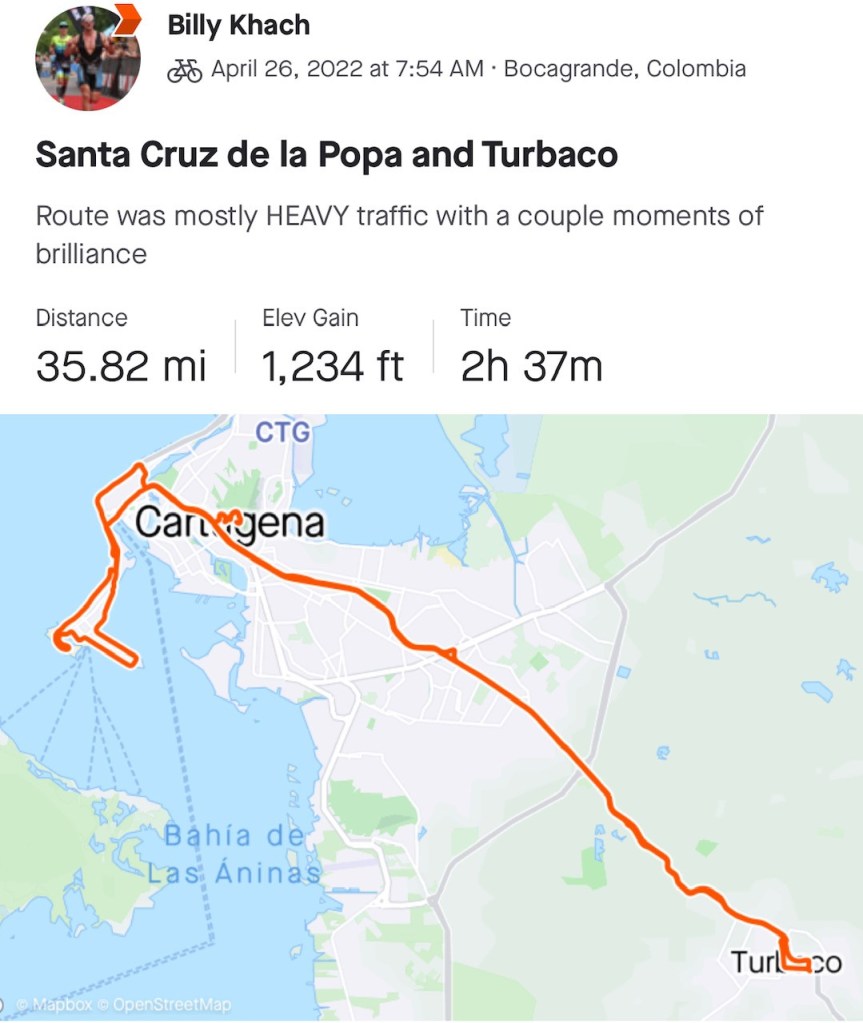
Santa Cruz de la Popa and Turbaco
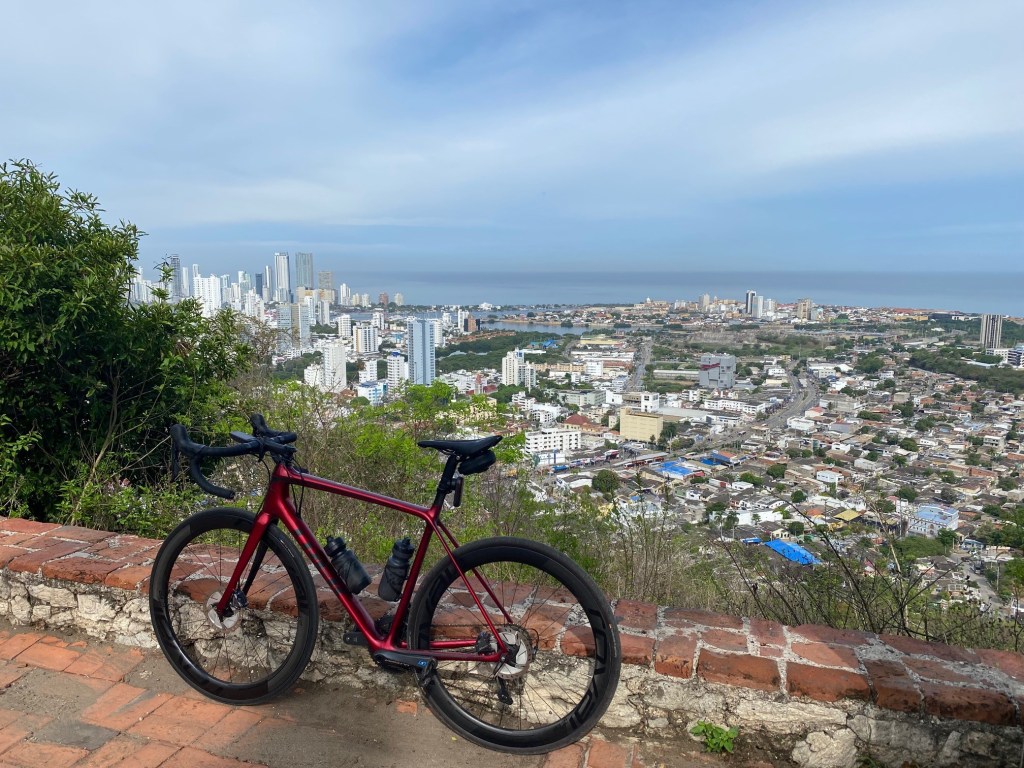
Santa Cruz de la Popa is an over 400 year old convent on a hill overlooking Cartagena just beyond the Castillo de San Felipe and is the only true climb to speak of in the city. The climb itself is short but challenging with switchbacks all the way to the top where the reward is a truly awesome view of the old city and the ocean at the highest point in the city. There also are plenty of vendors at the top of the climb to stop for a snack and to refill the bidons.
I do need to note that this is definitely outside of the tourist area of Cartagena. It is a very quiet climb that runs through an extremely poor area of the city with shanties set up along the hillside. I did not have any sketchy experience in my trips to the top of Santa Cruz or ever feel in danger, but be sure to be smart when heading to this part of the city. I wore my full Colombia cycling kit when venturing beyond the tourist areas of the city to do my best attempt at blending in. A lone gringo on a carbon road bike still sticks out like a sore thumb, but in my mind it definitely helped.
Leave all valuables at the hotel with the exception of your cell phone (and obviously your bike) and keep the phone wrapped up in a cloth or in a hip bag under your jersey as it would be very easy for anything in jersey pockets to get swiped by a motorcycle at a red light.
There is still a bike lane in this section of the city headed out to Santa Cruz; however, motorcycles use the lane as well.
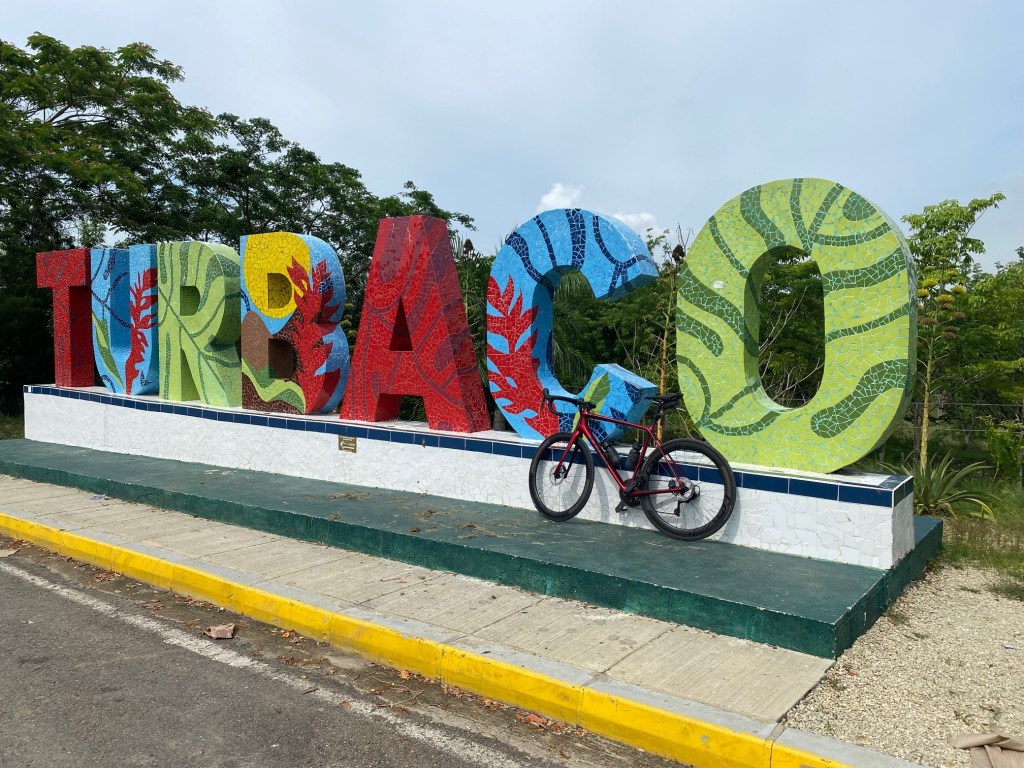
The first time I rode this climb I paired it with a trip to Turbaco. Outside of the city limits the road smooths out a bit and there is a beautiful large shoulder to ride, but Turbaco isn’t much of a destination to write home about. There’s a short climb into the town and a main square with an old church at the center, but at least it provides a brief respite from the city traffic.
Bocagrande and Castillogrande

These are the hotel areas and also home to the beaches frequented by many of the locals. There also are some nicer high rise condos making the area reminiscent of a mini version of Miami. The main road along the West side can be heavily trafficked and tight, but once you get around the bend there are wide roads with little traffic.
If you want to log a bunch of undisturbed miles there is a bike path along the bay on the East side that you can zoom back and forth on until you get sick of the same scenery.
It’s somewhat monotonous, but it is the safest route.

Cartagena’s Greatest Hits
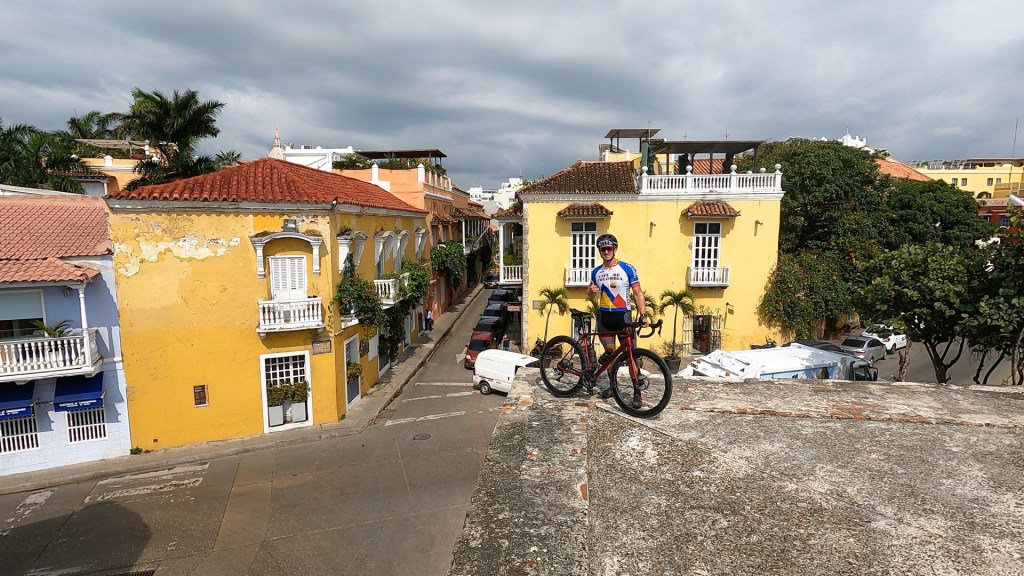
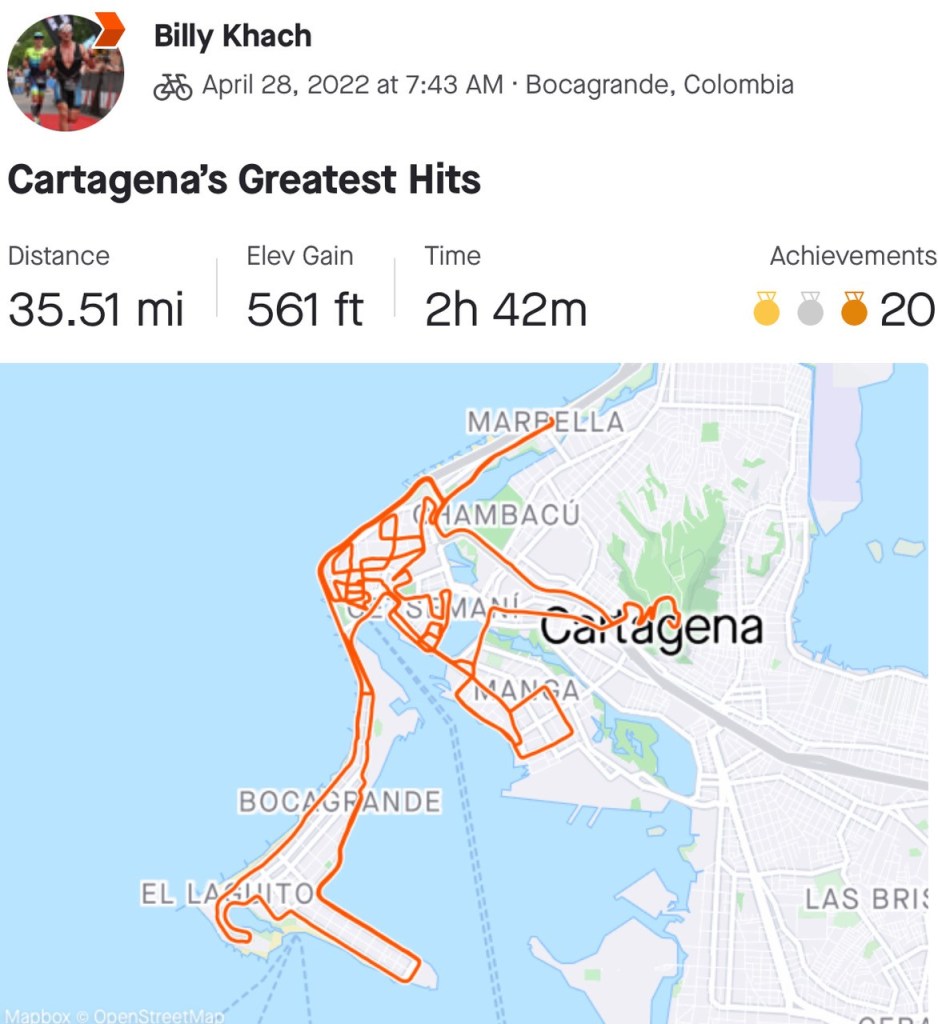
This route is for the bike tourist. This encompasses all of the “must see” parts of Cartagena. Don’t expect an average speed to brag about as you meander through tight, ancient streets, but it truly is awesome to explore a place like this from the saddle. Riding a road bike on 500 year old stone walls also is something to throw in your jersey pocket for a good café tale. This route includes the walled city, Getsamani, Santa Cruz de la Popa, the Castillo de San Felipe, Bocagrande, Castillogrande, and Manga. Bring the camera to capture plenty of photos of your carbon baby in front of exotic backdrops.

Route 90 towards Baranquilla
This route is one that shows up on search results for where to ride in Cartagena and is the road that bike packers will take on their way to the city from Santa Marta.
I was advised against this route by the local bike shops due to heavy traffic and after my experience riding to Turbaco which WAS recommended I decided to nix it from my itinerary, so I have no first hand experience or tips. It’s an option for anyone brave enough to give it a go.
From my experience driving this route on a past trip I can say expect to travel through some very poor areas of the country. As you get closer to Barranquilla the area has a reputation for being unsafe.
Final Tips and Notes
I used Bike House Cartagena in Bocagrande as my local bike shop for this trip. I can’t recommend them enough. They were extremely helpful and took great care of me and the Emonda on the cheap.
I strongly recommend some tough tires, like Gatorskins, and bringing at least 2 tubes with you when you go out. Even if taxis or ubers are readily available they are almost exclusively compact cars.
Know at least some key Spanish. Once you get away from the tourist areas English speakers are few and far between.
 Khach Me If You Can
Leave a comment