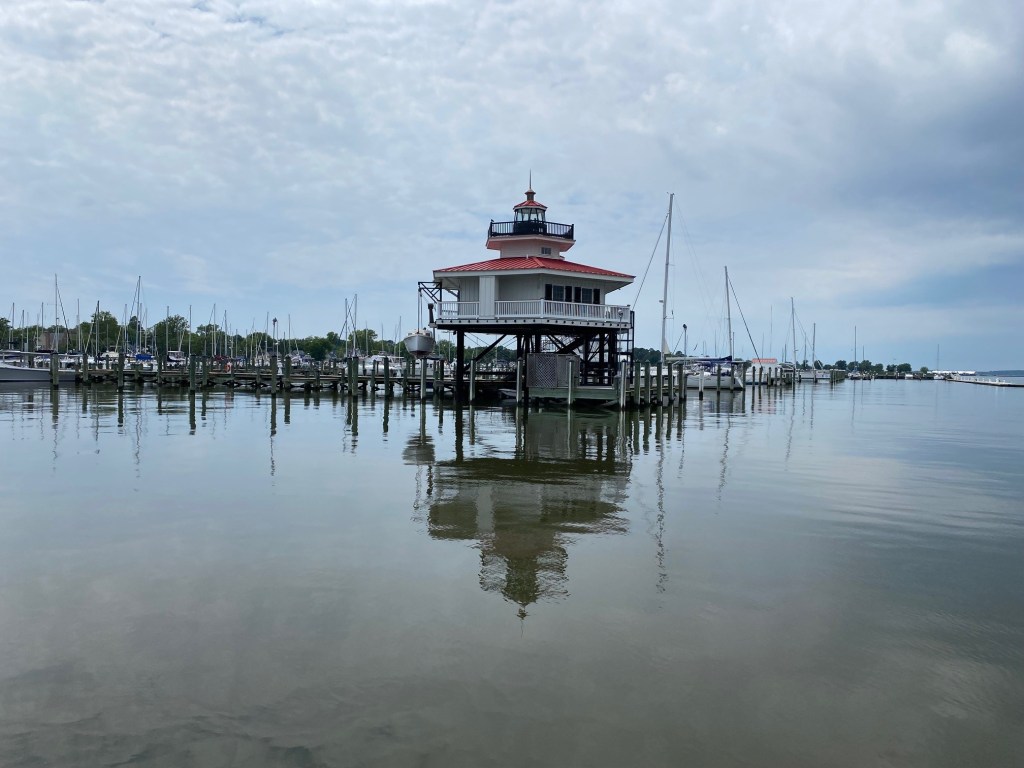
The Eagleman is one of the oldest sanctioned 70.3 races in the world. The race began in 1981 as the Oxford triathlon, moved to Cambridge in 1990, and was branded by Ironman in 1997 as the Eagleman. The race is known for 3 key attributes; heat, wind, and a lack of elevation. This can lead to some impressively fast times for athletes that can handle the heat and has become a popular race for both novices looking to finish their first 70.3 and experienced athletes hoping to set a blistering PR.
The race kicks off with a 1.2 mile swim in the Choptank River, followed by a 56 mile bike through the Blackwater National Wildlife Refuge, and finally brings it home with a 13.1 mile run through the quaint town of Cambridge.
Why the Eagleman?
Well I already touched on the flat and fast aspects of the course, but for athlete’s in the Northeast the ease of travel to the race also boosts popularity. It’s easy to drive to and there are three major hubs about 1.5 hours from the race with Baltimore (BWI), Dulles (IAD) , and Ronald Regan (DCA) airports.
My personal reasons for choosing this race to be a part of my 2022 season were a little bit different. My “A” race this year is Ironman Lake Placid, meaning the ideal time to race a 70.3 as a tune up is 4-6 weeks out. Despite not having any semblance of the hills I would be facing in Placid, the Eagleman was exactly 5 weeks before Placid putting it in the perfect timeframe. Having raced exclusively hilly 70.3s to this point I also liked the idea of going full-send on a fast course in what was likely to be a guaranteed personal best at the distance. Without having the luxury of a full taper for the race, and needing to get right back into training after the race, the ease of travel to the Cambridge from my home in Boston further boosted the race’s appeal.
(The absurdity to the “normal” person of racing a 70.3 to prepare for another race is not lost on me.)
Cambridge, Maryland
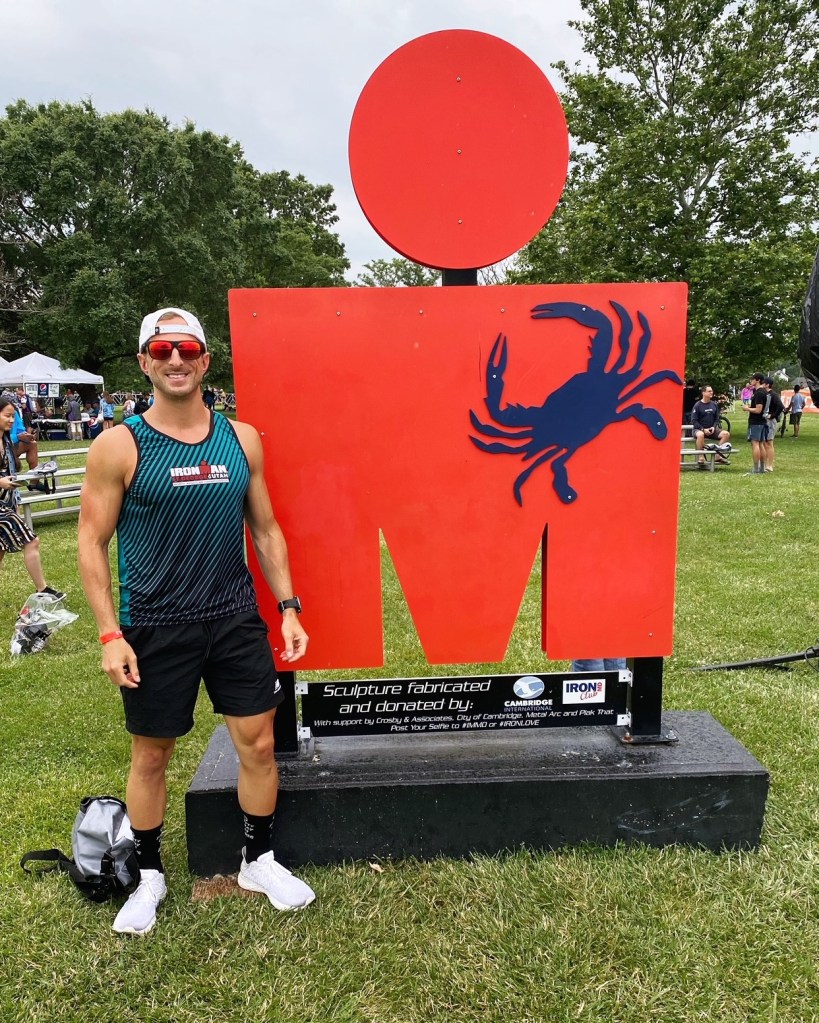
Cambridge is a picturesque town located on the Chesapeake Bay. It is known for its critical role as a stop on the Underground Railroad and later as a central part of the Civil Rights movements of the mid 1900s. Its also known for… well…. the Ironman races, with the Eagleman 70.3 taking place every June and Ironman Maryland each September. You can tell immediately upon visiting as there are Ironman branded statues, souvenirs, T-shirts, and signs in every business. 3,000 athletes swarming in from across the globe to a town with a population of 12,000 certainly makes for a grand event and nearly every local you talk to has a story of some kind of connection to the race whether it be offering rooms in their homes to athletes, volunteering at the race, or taking it in every year as a spectator. The center of your Eagleman experience for check in, transition, swim start, and run finish even is named after long time race director, Gerry Boyle.
Parts of the downtown may seem like rough areas, but in my experience everyone could not have been more friendly, even going out of their way to wave and say hello to these complete strangers of athletes that had invaded their town.
Because Cambridge is such a small town that gets a massive population bump 2 weekends out of the year, lodging is definitely a challenge. Airbnb and hotel rates quadruple for the races and all good option book up far in advance. If you are racing the Eagleman I recommend sorting out your lodging immediately. Residents will also post their homes for rent on Eagleman Facebook groups. I was able to stay in a 2 bedroom home about a half mile from the starting line for $1500 for 3 nights which ended up being a fantastically convenient option for check in, shakeout sessions, and most critically, race morning.
Bring the Heat
The biggest challenge with the Eagleman is the heat and humidity. Average air temperatures for the race are advertised as 80F; however some years this has been well into the 90s. With high humidity usually accompanying the high temperatures athletes lose nearly all of the evaporative cooling effect of sweating and core temperatures can climb. For this reason one of the best things you can do to prepare for race day is running through a heat acclimation routine a couple weeks out.
The heat also makes planning for the swim a challenge as it tends to be a toss up on whether it is wetsuit legal or not, often times with it coming right down to the wire on race morning. Don’t count on having those floaty legs race morning and, if you own a swim skin, pack it along with your wetsuit.
The Swim

The swim is a 1.2 mile counterclockwise route in the brown silty water of the Choptank River. The average water temp is 75 F, which puts it right near the line of the wetsuit legal cutoff of 76.2 F. The day before this year’s race officials were advertising a temperature of 76 degrees. After some overnight thunderstorms the water temperature race morning was 75.6 meaning it was wetsuit legal, but also certainly “wetsuit uncomfortable”.
Sighting buoys are typically put out last minute to avoid getting in the way of boats making their way to the designated crabbing areas that keep the local restaurants full of the crustaceans that are destined to be coated in Old Bay seasoning. Much of your swim is in relatively shallow water so if you stand up you may give the critters an opportunity to get revenge on your toes.
In addition to the famed (and delicious) local wildlife, some years the race has featured a bay full of Sea Nettle jellyfish that can result in unpleasant and annoying stings on race morning, especially if having a go at it sans wetsuit.
Tidal currents also can make the swim a bit challenging not only due to fighting the current but being pulled sideways at times requiring frequent sighting.
Race morning the air was warm and humid. As soon as the announcement was made that there was 15 minutes left until transition closed the mass migration to the porta potties began. I felt like I had hydrated well taking in electrolytes and fluids consistently the day before and all morning. Feeling confident I pulled my wetsuit over my legs and left the top half dangling to try to avoid sweating before the race.
In past races I had opted to swim wide to avoid the royal rumble of 3000 athletes kicking and punching in the water, but this inevitably adds a couple hundred extra yards and the effort in training to bring my swim pace down wouldn’t be reflected in my race times. Today the plan was to hug the buoys as tightly as possible and deal with any punched and kicks that came with it.
I positioned myself with the 30-33 minute swimmers in the starting field and waited until the last possibly minute to fully don my wetsuit over my arms and zip up. I was happy I did, as with the sun now peaking out from the clouds I instantly began to heat up in my neoprene cocoon. When my time came to start I ran into the water and immediately swam into my tempo effort, hoping to catch a draft on the heels of someone slightly faster than me. The warm water did not offer much relief, this definitely was a moment that I wished I owned a sleeveless wetsuit.
This is a good time to talk Ironman self-swim seeding. Athlete’s tend to be overly confident…. which is a nice way of saying they are liars. Every Ironman race I’ve done even if I seed myself slightly faster than my expected time I immediately run into a wall of slow swimmers and with my honest seeding on race morning this day was no exception. The first 500 yards was constant sighting and overtaking which added a bit of intensity at the start of the race I was hoping to avoid, nonetheless I was feeling strong and was able to settle into the pack after some short bursts.
The first 900 yards of the swim headed directly towards the Choptank lighthouse and into the current. Swimming into a current amplifies the penalty of any form inefficiencies so it’s critical to keep that form tight. Heading back in to T1 on the second leg of the swim the current gave a slight assist but also was trying to pull me out into the bay. Frequent sighting was critical to make the adjustments needed to stay on path.
I finished the swim and ran into T1 at 34 minutes. Not a bad swim by my measure, especially factoring in the current.
T1
Coming out of the water feeling strong I began my 0.25 mile jog to the transition area while simultaneously stripping my wetsuit from my torso. This was when unexpected problems hit. My quads AND hamstrings on BOTH legs completely locked up on me. I have never had this happen after a swim before and it was totally unexpected. I couldn’t even walk to my bike and had to drop to the ground to stretch and wait out the cramps. With an issue like this so early in the race I feared my day was basically over.
Due to my AWA status I had an absolute gem of a racking location right next to the pro field. Unfortunately this advantage was wasted with my time spent rolling around in the grass. Once I got to my rack I popped a couple salt stick tabs, took in some fluids, and gingerly jogged my bike out of transition in hopes of saving the day.
More on possible causes of the awful early cramps later…
The Bike
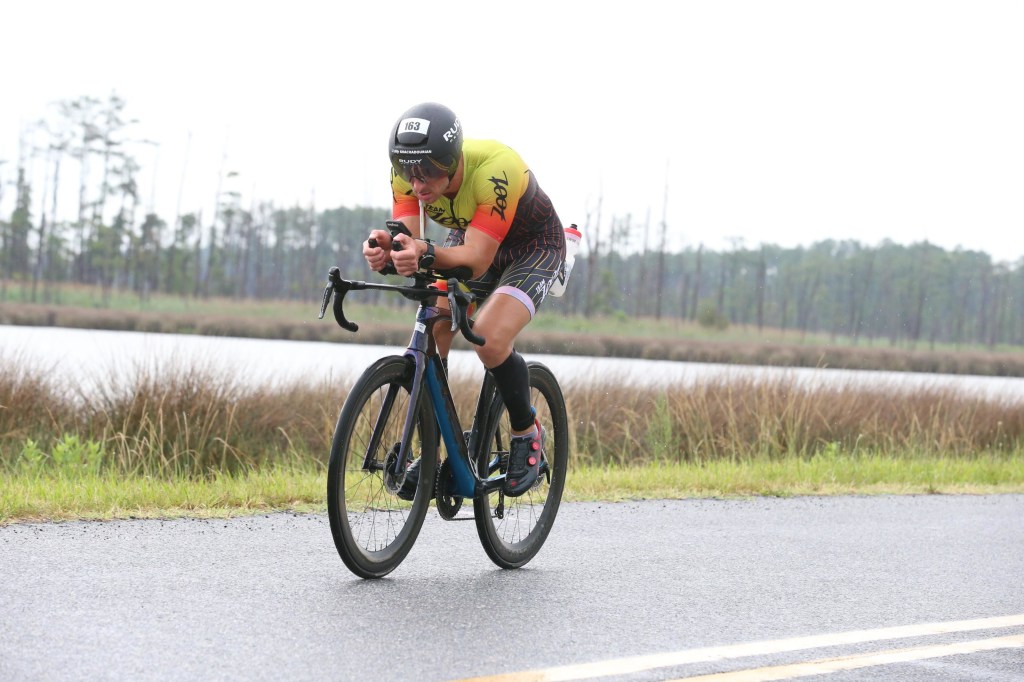
The bike kicks off at the exit of Gerry Boyle Park, through the Cambridge suburbs, and quickly into the Blackwater National Wildlife Refuge. The refuge is a sanctuary for migrating birds and offers beautiful marshy scenery to distract from the pain in your legs. The 56 mile bike course is known for being flat and fast with only 322 ft of elevation gain over the distance. However, the course can present strong winds making a good aero position all the more critical.
This year the course was humid and wet with long periods of light steady rainfall. The visor of my TT helmet immediately fogged up forcing me to ride most of the bike leg with the visor attached to the magnet clip on the top of the helmet with my face taking the rain and tire spray head on.
For the first 10 miles or so I was close to my power targets, but then my fear began creeping up on me again as my hamstring began to twitch signaling another cramp was imminent at the current workload. My lower back also began to tighten up seeming indicative of a poor saddle position in my attempts to get lower and more aerodynamic. I was frustrated to be hamstrung (pun intended) in my strongest discipline on such a fast course but “Oh well” I thought, this race is basically a tune up for Lake Placid so better to find these things out now than in the full distance race.
The winds weren’t overly powerful at about 10-15 mph, but it seems like no matter which direction the race took there was never a tailwind, always taking the elements head on or at best case a crosswind. It was something everyone was going to have to deal with so no big deal, but I would be lying if I said I didn’t miss that feeling with the wind at your back akin to the satisfaction of scissors beginning to slide when cutting wrapping paper.
While maintaining as aero of a position as possible I pushed as much power as my legs would allow without cramping, about 65-70% of FTP, and hit the bike finish at 2 hours and 17 seconds.
T2
The bike in at the Eagleman is a bit long with the chute into the transition zone from the dismount line about 0.25 miles long, wrapping around transition on the grass before opening up on the far side of the zone. I was told this was the only way to set up transition so as not to give an extreme favorable position based on bike rack position, which makes perfect sense, but was still a bit frustrating.
I downed a couple more salt tablets while stomping my tying the laces on my New Balances and headed off for the final leg of the race.
The Run

After exiting Gerry Boyle Park yet again the run kicks off with a few miles along the Chesapeake Bay and some of the best views in the race in my opinion. After this the 2 loop run winds through a few housing developments before heading back to the finishing chute. The run also is remarkably flat with just over 100 feet of elevation gain over the 13.1 miles. This is where athletes face the full brunt of the heat the race is so well known for. In addition to high air temperatures and humidity, the run course offers very little shade, meaning that without the luck of cloud cover athletes can be blasted with UV rays as well.
I was happy to have added a few steam room sessions to my training program to acclimate a bit before the race.
I headed out at a good tempo pace when a mile in the cramps that had been haunting me came back with a vengeance. I stopped to stretch them out and massage my legs well for about 30 seconds then continued on at a slightly more conservative pace. My body felt strong to push a bit harder but the cramps were a constant speedcheck every time I tried to hit my target pace. With a half mile to go the cramping demons finally left my body and I was able to kick it up a notch to sprint into the finishing chute and across the line with an overall time of 5 hours 38 minutes.
Run time: 1 hr 34 minutes
Post Race Feels
The sun now came out in full force and I began melting sitting still. Thankfully I had finished just ahead of the worst of the heat. I definitely felt for the athletes still out there pushing for the finish. The post race meal was nothing to write home about, but I have a hard time eating right after a race anyways. A cold can of Coke was the best tasting thing in the world at that moment.
Initially I was torn between being stoked about a shiny new 70.3 PR and having left so much time on the table with the cramping issues. I felt like I could easily have shaved another 10-15 minutes off my time which would have put me well into the top 10 for my age group.
A few hours later that feeling changed to pure euphoria when I received a slot to the Ironman 70.3 World Championships at the roll down ceremony. My goal for 2022 was to make it to worlds and this race had just sealed the deal.
Cramp Theory 101
In order to find a way to exorcise my cramping demons I had to try to find out why it occurred in the first place. NEVER have my legs locked up like that coming out of a swim. There was no way I wanted this issue lingering over my head while going for the full distance the next month. No reason can be determined definitively, but there are a couple potential issues that I have tried addressing in training since with no further issues.
Hydration and Salt
Hydration is the obvious first thought people go to for anything cramping related. I had spent the entire day before the race sipping on electrolytes and was sure to add in extra salt on race morning. I felt that I was hydrated properly, but sitting in the swim start shoot with a wetsuit on in the hot and humid conditions followed by a warm water swim may have dried me out much quicker than I expected. This is the major reason I find deciding to go with a wetsuit or not when near the temperature cutoff is difficult.
Carbohydrates
In speaking with my coach post race he shared a theory that carbohydrate depletion can contribute to cramping issues. There’s no way to determine if this actually was the case and I was surprised to have it happen so early if this was the case, but it’s possible I went a little too hard in the swim and/or didn’t carb load as well as I should have before the race. Moving forward I’ve upped my carb intake during key workouts.
Wetsuit and Sighting
Due to the tricky tidal currents I was raising my head frequently to sight. This movement puts stress on the lower back and posterior chain. In addition to the sighting most of my training winter through the spring was in the pool without a wetsuit. The wetsuit helps elevate your legs with the added buoyancy and can further stress the posterior chain, potentially contributing to cramping. Moving forward my plan is to incorporate a lot more wetsuit swims to train those underutilized muscles better.
Next up, Ironman Lake Placid 140.6 on July 24th, with a few more gels and salt tablets added to the game plan.
 Khach Me If You Can
Leave a comment